

Speed or Accuracy: How to Find a Professional Balance in Laboratory Research
For a specialist working with biochemical analyzers, this is an eternal dilemma: should we rush, risking an error, or stick to a conservative pace that the clinician perceives as inefficiency? In a modern laboratory, “speed” and “accuracy” should not be antagonists — they should become elements of a balanced system.
1. Conflict of expectations: the clinician and the laboratory technician’s perspective
For a clinician, the turnaround time (TAT) is a critical indicator of service quality. For a doctor, speed means the ability to immediately adjust therapy, especially in urgent conditions. On the other hand, for a laboratory technician, analytical reliability and the absence of preanalytical errors are a priority.
This divergence in perception is natural. The clinician sees the “end point” — the patient, while the laboratory technician sees the “process” — a complex sequence of stages where every second affects the result. Finding a balance means stopping seeing these expectations as mutually exclusive.
2. Optimization without compromise: Lean and automation
How to shorten the sample path without sacrificing quality? The answer lies in the principles of Lean management. Optimizing the workflow is not about speeding up the measurements themselves, but about eliminating “bottlenecks” — unnecessary steps, expectations, or duplication of functions.
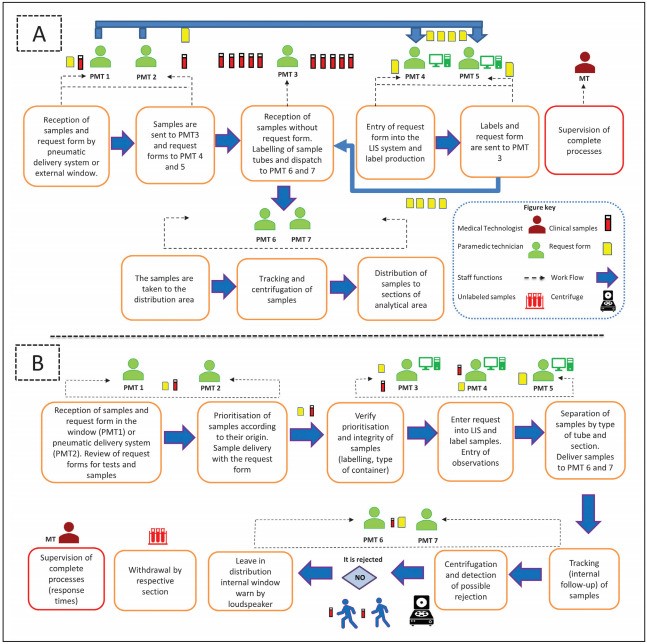
As shown in the diagram above, the traditional sample route (A) is often overloaded with unnecessary logistics. The transition to an optimized workflow (B) allows for the synchronization of sample movement and referrals, early prioritization, and instant registration in the LIS. This significantly reduces the waiting time (TAT) and minimizes the risk of human error without affecting analytical accuracy.
3. Technical solutions: where is acceleration possible?
There are parameters where optimization is completely safe. For example, studies show that with proper standardization of centrifugation and sample preparation protocols, preparation time can be reduced without risking clinical validity.
The main rule: only standardized, validated processes can be “accelerated”. Technical accuracy should be enshrined in SOPs (standard operating procedures) that are non-negotiable, while logistical steps should be continuously improved.
4. Conclusion: service through quality
Accuracy is the foundation, without which speed turns into a dangerous illusion of the result. However, in the modern MedTech environment, where we often work with high loads, speed is a tool for service and clinician loyalty.
A true professional builds a balance not on a constant “choice” between two extremes, but on building a systematic work:
• Clear communication: explain to clinicians why certain tests take time.
• Constant automation: invest time in firmware settings and optimization of analyzer software.
• Risk-oriented approach: where the cost of error is high — choose accuracy, where the cost of time is critical for life — use standardized express protocols.
Finding this boundary is the pinnacle of laboratory art.