

International external quality control: how to guarantee the accuracy of results in a clinical laboratory
The main tool that guarantees accuracy at the global level is the International External Quality Assurance (EQA) or Professional Testing (PT).
What is EQA and how does the independent assessment system work
External quality assessment is the process of comparing the test results of a particular laboratory with the results of an independent external source. Unlike internal controls that a laboratory conducts daily to check the stability of its systems, EQA allows you to evaluate the work objectively "from the outside".
According to international practice, there are four main methods for implementing this process:
• Proficiency Testing: The organizer sends "blind" samples with unknown content to a group of laboratories. The results of all participants are analyzed and compared with each other.
• Retesting: Repeated examination of samples in a reference (standard) laboratory to verify accuracy.
• Interlaboratory Sharing (ILC): Direct exchange of samples between several institutions to compare results.
• On-site assessment: Direct verification of laboratory operations by external experts directly on site.
Why participation in PT programs is critical for a laboratory
Participation in professional testing programs (according to ISO 17043) is not just a formality, but solving strategic objectives of the institution:
1. Detection of systemic errors. Internal controls may demonstrate perfect stability, but due to incorrect calibration or wear of equipment, results can be biased. EQA helps to detect these deviations before they affect the patient's diagnosis.
2. Metrological traceability. International control links your results to global standards. This means that the analysis performed in your laboratory will be valid and understandable to a doctor in any country in the world.
3. Objective proof of competence. EQA results serve as documentary evidence of quality for patients, insurance companies, and accreditation bodies.
4. Continuous staff training. Report analysis is a powerful educational tool. It helps staff gain a deeper understanding of the specifics of research methods and technical limitations of the equipment.
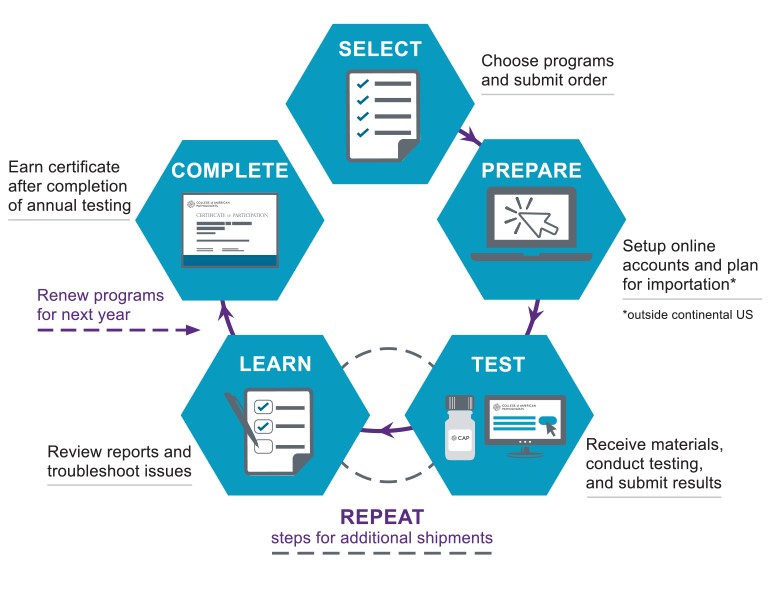
5 steps of the external control cycle: a practical algorithm
Professional testing is a continuous improvement cycle that the laboratory goes through step by step:
• Selection and planning (SELECT): Determining the list of indicators (biochemistry, hematology, immunology, etc.) that require verification, and registering for participation in the program.
• Preparation and logistics (PREPARE): Setting up access to digital reporting systems and planning the receipt of control materials with compliance with the temperature regime.
• Conducting the study (TEST): The laboratory receives a “control sample”, tests it as a regular patient sample, and sends the results to the provider.
• Report analysis and correction (LEARN): After receiving the comparison results, specialists analyze deviations. If there are any, troubleshooting is performed and errors in the work processes are corrected.
• Completion and recognition (COMPLETE): After completing the annual plan, the laboratory receives a certificate confirming the high quality of its diagnostics.
Risk Management and Patient Safety
Today, the laboratory is considered as a holistic system, including three stages: pre-analytical (preparation), analytical (test) and post-analytical (interpretation). External quality control allows you to identify risks at each of them.
Thanks to EQA data analysis, the laboratory gets the opportunity to identify problems in the processes before they lead to a clinical error. This allows you to confidently validate the results and determine the needs for additional technical service or staff training.
International external quality control is the “gold standard” of modern diagnostics. It transforms the laboratory from a performer of technical tasks to a reliable partner for the doctor and the patient. The introduction of regular professional testing is an investment in the reputation of the institution and, most importantly, in people's health.

